Why B2B Software Sales Is the Hardest (and Highest-Paid) Sales Career
B2B software sales has one of the lowest barriers to entry and the highest income ceiling of any career you can start without an elite degree. Top reps clear $300K to over $1M a year. But the same things that make it lucrative also make it brutal. This post breaks down honestly why software sales pays so well, why it's so hard, and who it's actually right for.
B2B software sales has one of the lowest barriers to entry and the highest income ceiling of any career you can start without an elite degree. Top reps clear $300K to over $1M a year. But the same things that make it lucrative also make it brutal. This post breaks down honestly why software sales pays so well, why it's so hard, and who it's actually right for. It's written for anyone looking to break into software sales or anyone stuck in a stable career watching salespeople out-earn them.
What You'll Learn
Why software sales pays more than almost any other sales track
The real reason software companies hand reps six-figure commission checks
The mental and emotional difficulty most people underestimate
Why being smart isn't enough to win in this career
How to decide if B2B software sales is right for you
Context: Why This Matters
Social media is flooded with sales content. People in solar, car, high-ticket, and software sales posting from penthouses or their parents' SUV, all promising easy money. It's noise. Almost none of it tells you what the job actually feels like day to day.
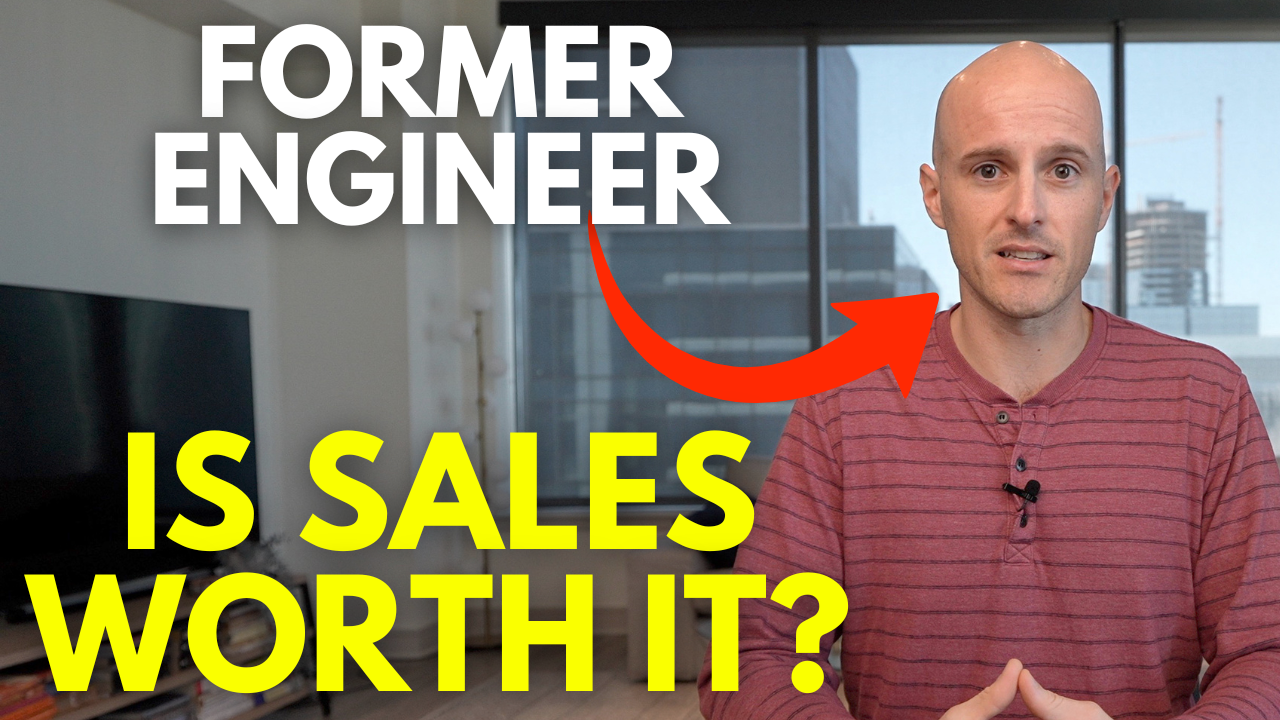
Here's the honest version. After three years as an engineer, fed up watching salespeople make triple and quadruple my income, I left to go into B2B software sales. In three years I quadrupled my income. It also became one of the most stressful periods of my life. Both things are true. If you're going to make this move, you should understand both sides before you do.
Why Software Sales Has the Best Risk-to-Reward Ratio
Software sales is unique because it pairs one of the lowest barriers to entry with the highest upside of any career path.
You don't need a degree, same as solar, car, or high-ticket sales. But unlike those tracks, the long-term ceiling is in a different universe. Fast forward three to five years and the companies you get to work with, the deal sizes, and the career options are nowhere close to what other sales paths offer.
Within about five years in software sales, if things go well, you can be clearing $300K a year. Top enterprise and strategic account executives consistently earn half a million to a million-plus annually. For someone with a high school diploma or undergrad degree who can't break into a track like investment banking, it's one of the only paths to that kind of money working at the best companies in the world.
Why Software Companies Pay Reps So Much
This is the part most people never understand. Software sales pays well because of how software economics work.
Software is built once and distributed to millions or billions of people at a near-fixed cost. Compare that to selling solar panels or real estate, where physical products create bottlenecks that cap how fast you can sell and how much margin exists per sale.
Now add valuation multiples. Software companies often trade at a 5 to 10x multiple, sometimes much more. So when you close a $1M deal at a company valued at 10x earnings, you didn't just bring in $1M, you increased the company's valuation by roughly $10M. Paying you a $100K commission on that stings a little, but the company just grew its valuation by $9.9M for the price of your check.
That's the leverage. It's why the best companies pay top performers a million dollars or more. Sell a car and you barely move the company's valuation; you'd need to sell millions. Software is different, and that difference shows up in your paycheck.
Why Sales Is Harder Than It Looks
Engineering has a tangible output. School has an answer key. Sales has neither.
You can say all the right things, build the right business case, and be genuinely right that your product is superior, and still lose. Budget freezes. Layoffs. A new champion who prefers the competitor. Ten people on the team already use another tool and don't want to switch. Most of what decides a deal is outside your control.
You can do everything right for three, six, even nine months, and then the economy turns, budget shifts to AI, and the work vanishes. That's hard for anyone, especially smart people coming from careers where effort reliably produces results.
"You can be working a half a million dollar deal nine months in and right before your 18th meeting they email you, 'Hey, we've decided to pause this.' They don't take your calls. They block your email. And you're done."
Every quarter your number resets to zero. If you're not built for that, or not prepared for it, it will break you.
Why Raw Intelligence Isn't Enough
There's a baseline of intelligence you need. If you're selling cybersecurity or cloud infrastructure, you have to be sharp. But intelligence is the floor, not the edge.
Software sales is deeply consultative. It rarely has anything to do with the high-pressure tactics you see on platforms like TikTok or YouTube. In 99% of cases you're uncovering and solving a true business need, not pressuring someone to buy today. The only thing you ever push for is a meeting or a clear next step. Beyond that, the job is depth. In an enterprise role you might fly on-site and spend two days in a server room learning what a team is actually trying to do.
Your job is to understand their tech stack, why they can't accomplish their goal today, what the impact of that gap is, and what happens if nothing changes in 6 to 12 months. A global bank has hundreds of thousands of problems at any time. You have to answer: why this problem, and why now? Smart engineers often nail the technical part immediately. What trips them up is the political navigation, the human-to-human ambiguity, and the emotional resets that come with the territory.
Why It's the Best Skill to Build Right Now
If you can sell something genuinely complex, an engineering-heavy tool, you've built the hardest version of the skill. Pivoting later to real estate, solar, or high-ticket becomes easy. The reverse is not true.
On top of that, being on the front lines of how businesses are adopting tech and AI is one of the most valuable vantage points you can have right now while the market shakes out. That's why I push people toward B2B software sales specifically, assuming you can handle the ups, downs, and constant pressure of carrying a quota.
Just know what you're signing up for. Early on it's a grind: calls, emails, and rejection every day. Some of the best reps in the world close around 30% of their deals. By definition they win three times and lose seven. If you're not ready for that math, survival is hard. If you are, and you look at this with a five-year lens, the money is genuinely life-changing.
FAQ
Q: Is B2B software sales worth it? A: For the right person, yes. It has a low barrier to entry and one of the highest income ceilings in any career, with top reps earning $300K to $1M+. The tradeoff is high stress, constant rejection, and results that reset every quarter.
Q: How much can you make in software sales? A: Within about five years, strong reps can clear $300K a year. Enterprise and strategic account executives consistently earn $500K to $1M+ annually.
Q: Why does software sales pay so much more than other sales jobs? A: Software has near-fixed costs and scales to millions of users, creating huge margins. Companies also trade at high valuation multiples, so a single closed deal can raise the company's valuation by many times the deal size. That leverage flows into rep compensation.
Q: Do you need a degree to get into software sales? A: No. It's one of the few high-income paths open to people with a high school diploma or undergrad degree, with no elite credential required.
Q: Is software sales hard? A: Yes. Much of what decides a deal is outside your control, the work is emotionally demanding, and your number resets every quarter. Intelligence is required but not enough on its own.
Ready to Break In?
If you're trying to break into software sales and want a clear path instead of guesswork, check out Tech Sales Ascension and join our free community to learn what the career actually takes before you make the jump.
TL;DR
Software sales pairs a low barrier to entry with the highest income ceiling of any non-elite career path; top reps earn $300K to $1M+.
Software economics and high valuation multiples mean one deal can raise a company's valuation by 10x the deal size, which is why reps get paid so well.
It's brutally hard: most deal outcomes are outside your control, the work is emotionally draining, and your number resets every quarter.
Intelligence is the floor; consultative depth and political navigation are the real edge.
If you can handle the pressure and think in a five-year horizon, it's the most valuable sales skill to build right now.
.svg)
.svg)
.svg)
.svg)
.svg)
.svg)


.png)
.png)
.png)

.svg)