Will AI Replace Sales Jobs? The Roles at Risk and the Ones Getting More Valuable
Will AI replace sales jobs? No, but it will replace reps who refuse to use it. Here's which sales roles are at risk, which are getting more valuable, and the AI workflows every rep should build now.
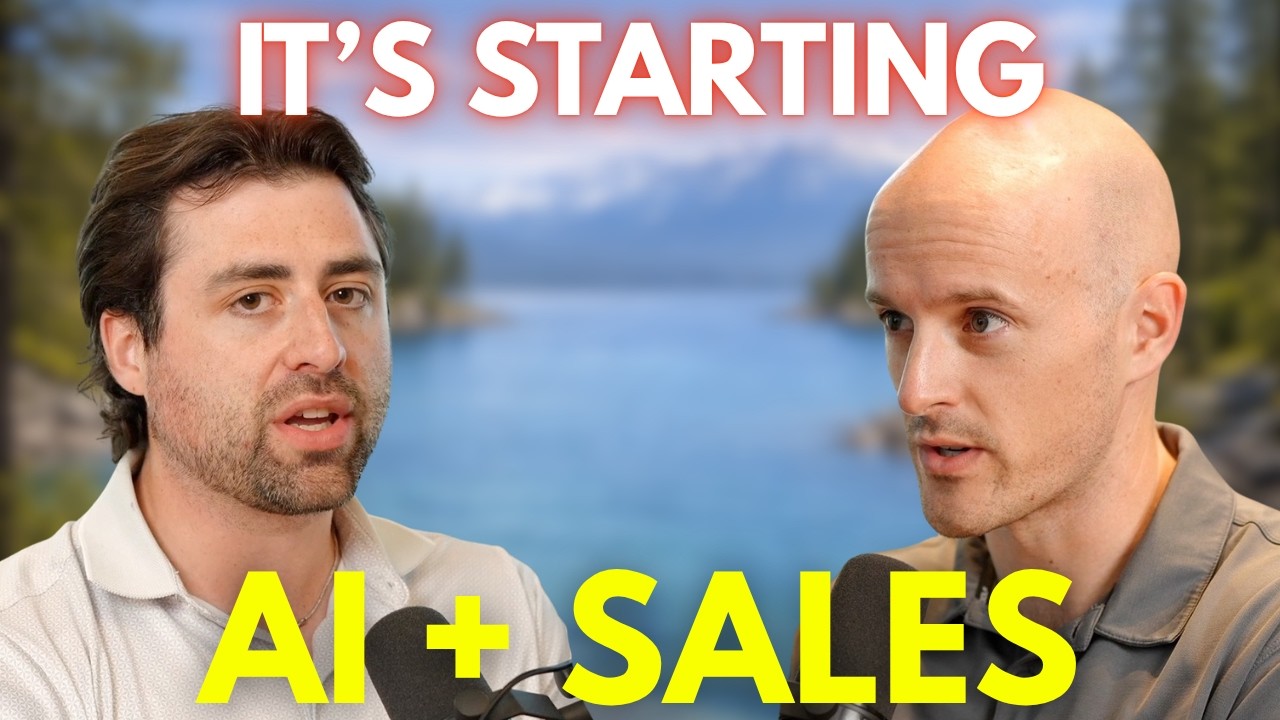
Will AI replace sales jobs? Short answer: no. But AI will replace the sales reps who refuse to learn how to use it. In this breakdown, Eric Finch and Connor Murray walk through which sales roles are actually at risk, which ones are getting more valuable, and the exact AI workflows reps should be building right now. This post is for mid-level reps (1 to 4 years in) who want to stay ahead of the curve and keep growing their earnings.
What You'll Learn
Why AI is not replacing sales jobs, but is splitting reps into two very different tiers
Which sales roles and companies are most exposed to AI disruption
The AI workflows that save top reps hours every single day
Why a "good enough" prompt is not the same as a real AI system
How to position yourself for the next 6 to 12 months and the next 3 to 5 years
Context: Why This Matters
Every new AI model launch comes with the same headline: sales is dead. When ChatGPT first came out, the common prediction was that SDR roles had a year, maybe two, before they disappeared. Five years later, most sales jobs look almost identical, and the companies that tried to swap reps for fully automated AI solutions have, in Eric's words, "kind of failed spectacularly."
That does not mean nothing is changing. Hiring growth has stagnated, teams are being asked to do more with less, and buyers can now research and trial products on their own before they ever talk to a rep. The mistake most reps make is landing on one of two extremes: panicking, or assuming they are safe and doing nothing. The truth sits in the middle.
"AI is going to replace sales people that don't learn how to use AI. That's really what it comes down to." - Eric Finch
Will AI Replace Sales Jobs? The Short Answer Is No
AI will not replace sales as a function, but it will replace reps who stay manual. Both Eric and Connor agree on this point. Different roles get impacted differently, and sales is not the role taking the biggest hit.
Look at software engineering as a warning against overconfident predictions. For years the common take was that AI would wipe out engineers. Eric points out that the opposite has happened, with hiring for engineers picking back up. Sales is following a similar pattern: AI changes the work, but it also creates new opportunities and, for the right people, higher-paying sales jobs.
Connor shared a framework he came across, attributed to Cloudflare's CEO, that splits employees into three groups:
Builders: engineers and product people who create what gets sold
Measurers: back-office roles in finance, IT, HR and reporting that track and organize data
Sellers: the people who bring new products to market
In that breakdown, builder roles were growing, seller roles were holding steady or growing, and measurers were taking the biggest hit, because centralizing, tracking and reporting on data is exactly what AI does best. Treat it as one data point, not gospel, but it lines up with what both hosts are seeing in the market.
The K-Shaped Sales Market: Why Elite Reps Become More Valuable
The gap between great reps and average reps is about to get much wider. Connor compares it to a K-shaped economy: the top gets stronger while the bottom gets squeezed.
Buyers now have more access to information than ever. Many companies are pushing product-led trials because people want to try a product before they talk to sales. So where does the rep fit? The reps who win will be the ones who can use AI to cover 1.5x to 2x the territory they cover today, and who are true experts when a buyer finally shows up with questions.
On the other side, the rep who fell into sales and treats it as just a job to pay the bills is in trouble. As Connor puts it, if a buyer asks a basic product question and your answer is "Let me check with my solutions consultant," that era "is completely over."
What to do instead:
Learn your product deeply enough to answer most technical questions on the spot
Use AI to research accounts and prep calls so live conversations get your full attention
Lead the sales cycle instead of routing every question to someone else
Which Sales Roles Are Most at Risk
The roles most at risk are the ones built around manual, repeatable work and handoffs. Eric expects the account executive and solutions engineer roles to converge over time. Historically, you needed one person to run sales activities and update the CRM, and a separate person who spent the time to get technical and run demos. Managing two calendars for every deal is inefficient, and AI makes it possible for one person to do work that used to need two full-time roles.
The hosts opened the conversation with a recent example: Notion moving away from the account executive title toward solutions consultants. Expect more of that. Titles may change, but the direction is clear: technical depth plus sales execution in one seat.
On the hiring side, Eric's read of the data is that growth has stagnated rather than declined. Younger companies building out sales teams are asking whether they need 20 SDRs or whether 10 will do. Established companies, meanwhile, are hesitant to make sweeping cuts because several public attempts to go all-in on AI have backfired.
Which Companies Are Safer to Sell For
Core platforms deeply embedded in enterprise workflows are harder for AI to replace than single-feature tools. Eric is clear that nobody knows exactly how this plays out, but the pattern is common sense.
Safer: broad platforms like ERP systems or IT service management platforms that run core business processes
Riskier: one-trick tools that pull data from those core platforms and turn it into charts or simple outputs that AI can easily recreate
If you are evaluating your next role, ask a simple question: if a customer had a strong AI assistant connected to their core systems, would they still need this product? If the honest answer is "probably not," be cautious.
The AI Workflows Every Sales Rep Should Build Now
The biggest unlock is connecting AI to the tools you already use every day. Most reps still treat AI as an email polisher. That is the boiling frog trap Connor warns about. Here is the progression he lays out:
V1: Paste an email into ChatGPT and ask it to sound more professional.
V2: Build a dedicated project (called Projects in ChatGPT and Claude, Gems in Gemini) with specific instructions for how you write emails, then feed it a call transcript and let it draft the follow-up.
V3: Connect your AI to enterprise tools like your CRM, email inbox, calendar and Slack so it can pull information and run workflows for you.
Connor's own example: every morning he used to check email, then his calendar, then research the companies on that day's calls, then catch up on Slack. That was roughly an hour and a half of his day. He codified the whole routine into an AI daily briefing that tracks his largest accounts and lands in the exact format he would have built by hand. In his words, what used to take 60 hours a week now takes 10 to 15, and the freed-up time goes to high-value customer conversations.
Eric adds the everyday use cases that are easy to systematize:
Cold call scripts and email templates
A repeatable framework for discovery call prep
Post-call follow-up emails
A dedicated project for every active deal, kept updated with full context
Talk tracks for demos and call openers
Quick tip: Don't use AI to invent new work. Start by writing down what you do every day, step by step, and automate that first. As Connor puts it, save your brain capacity for live conversations where it really matters.
Why One Prompt Is Not an AI System
Real AI leverage takes hours of iteration up front, and most reps underestimate it. Eric says his own GPTs for basic tasks like email templates and cold call scripts took four to five hours each to dial in.
The common mistake is writing one prompt like "write professional emails for my company" and calling it done. The first output might look fine, but as soon as you start responding, quality drops and the GPT forgets the original framework. Getting it right means iterating:
Round 1: good output, but the language is off
Round 2: remove all passive language
Round 3: always ask for the meeting and propose a couple of dates
Round 4: lock specific instructions so they never get changed
The math works out fast. Eric used to spend 60 to 90 minutes every evening writing follow-up emails. If four hours of setup cuts that to 15 minutes a day, the investment pays for itself in two or three days.
Connor also recommends using voice dictation to talk to your AI tools instead of typing. You can give five to 10 times more context in the same amount of time, which dramatically improves output quality.
How to Position Yourself for the Next 3 to 5 Years
Learn to separate signal from noise, and tie every AI win to a business result. It is tempting to show off a flashy AI-generated graphic for a customer. But did it close the deal? Hiring managers care about reps who can explain how they codified meaningful workflows and what those workflows produced.
Weak: "I create all my proposals with AI."
Strong: "Our proposal process was slow, so I connected Claude to Salesforce and now build proposals in a fraction of the time, which helped shorten our sales cycle."
Eric's point is blunt: if all you can show is that AI took an eight-hour task down to three, leadership will ask where the results are. Frame your wins around:
More meetings booked or more accounts covered
Shorter deal cycles
Larger deal sizes
Higher conversion rates
Connor shares two examples from running Higher Levels. First, every YouTube transcript is turned into a blog post through a dedicated AI skill connected to the website, and organic clicks to higherlevels.com doubled over 12 months. Second, when prospects ask whether Higher Levels has helped students in their country, an AI workflow scans the entire testimonial bank and pulls relevant quotes in about 10 seconds. Both tie directly to revenue.
Finally, share what you build with your team, even if it is rough. Being seen as the person at the front of the curve inside your organization is one of the best career moves you can make right now. And if you are early in your career, Connor's view is that learning sales in the era of AI is one of the best hedges you can make, because so much else is still up in the air.
FAQ
Q: Will AI replace sales jobs? A: No. AI is replacing manual, repetitive sales tasks and the reps who refuse to adopt it. Reps who use AI to cover more territory and become true product experts are becoming more valuable, not less.
Q: Which sales roles are most at risk from AI? A: Roles built on manual handoffs and repetitive admin work. Expect the account executive and solutions engineer roles to merge over time, and expect fewer SDR seats at companies trying to do more with less.
Q: What AI tools should sales reps learn first? A: Start with projects in ChatGPT or Claude (Gems in Gemini) for repeatable tasks like follow-up emails and call prep. Then connect your AI to your CRM, inbox, calendar and Slack to automate full workflows like a daily account briefing.
Q: How long does it take to build a useful sales GPT? A: Plan on several hours of iteration per GPT. Eric spent four to five hours each on his email and cold call GPTs, and that time paid for itself within a few days.
Q: How do I show AI skills in a sales interview? A: Tie each workflow to a business result. Explain the manual process you replaced, how you automated it, and what improved, such as meetings booked, deal size or cycle length.
Get Ahead of the Curve
If you want to skip the trial and error and start using AI the way top reps do, join our AI Sales Accelerator. You get pre-built GPTs for cold calls, emails, discovery and follow-ups, plus training on building your own AI workflows that save hours every week.
TL;DR
AI will not replace sales jobs, but it will replace reps who stay manual
The sales market is splitting: elite, AI-native reps gain value while average reps get squeezed
AE and solutions engineer roles are likely to converge into one technical seller
Core enterprise platforms are safer to sell for than single-feature tools
Build real AI systems connected to your CRM, inbox, calendar and Slack, and expect hours of iteration
Always tie your AI workflows to business results like pipeline, deal size and cycle length